These instructor-led Software Design training courses, available online or on-site, utilise interactive discussions and practical exercises to demonstrate the core principles of the discipline.
Participants can select between "online live training" or "onsite live training". Online sessions (also known as "remote live training") are conducted through an interactive remote desktop platform. Onsite training is delivered either locally at the client's premises in Durban or within NobleProg's corporate training centres in Durban.
NobleProg -- Your Local Training Provider
Garden Court South Beach
Durban, South Africa
Way to get there
From Durban city centre: follow the beachfront/Marine Parade south toward South Beach.
By car/taxi: give the driver the address 73 O.R. Tambo Parade, South Beach, Durban 4001.
From King Shaka International Airport: the hotel is roughly 30 km ;from the airport.
In this Durban course, teams utilise Design Thinking to resolve issues via empathy, ideation, and prototyping. With a focus on the Empathize stage, you will align pain points with internal client needs, turning insights into actionable outcomes through dynamic collaborative activities.
This live training on Durban equips teams and leaders with the Empathise and Define stages of Design Thinking. Participants will hone their active listening, empathy mapping, and 5 Whys techniques to uncover root causes and draft clear, actionable problem statements for internal stakeholders.
This instructor-led, live training in Durban (online or onsite) is aimed at beginner-level to intermediate-level professionals who wish to understand and apply Design Thinking methodologies to drive innovation and improve business solutions.
By the end of this training, participants will be able to:
Understand the core principles of Design Thinking and its role in innovation.
Apply the five phases of Design Thinking to problem-solving.
Utilise ideation techniques and tools to foster creativity.
Implement Design Thinking strategies to improve processes and enhance efficiency.
This guided, live training in Durban (online or on-site) targets beginner to intermediate learners who aim to resolve daily workplace challenges through gamification techniques.
Upon completion of this training, participants will be able to:
Grasp the core principles of Design Thinking and how they apply to problem-solving.
Utilise gamification techniques to boost engagement and drive innovation.
Craft creative and practical solutions for common workplace problems.
Collaborate efficiently across teams to deploy problem-solving strategies.
Apply iterative methods to refine solutions using feedback and experimentation.
This instructor-led training on Durban empowers senior developers with advanced Domain-Driven Design skills. Participants will learn to apply strategic and tactical patterns, define bounded contexts, and integrate DDD into Agile workflows to construct robust, scalable, and maintainable software systems.
This instructor-led live training in Durban (online or onsite) is aimed at intermediate-level developers, architects, and analysts who wish to learn and apply DDD concepts and practices to their software projects.
By the end of this training, participants will be able to:
Grasp core DDD concepts (bounded contexts, entities, etc.) and their application in software projects.
Apply strategic DDD to define and design the domain model, identify subdomains, and establish boundaries.
Implement tactical DDD using patterns such as CQRS, factories, and event sourcing.
Refactor and modernize legacy systems effectively with DDD techniques.
Design and implement product, domain, and team-oriented architectures.
Utilize data mesh to create a domain-oriented data platform supporting data discovery and governance.
This instructor-led, live training in Durban (online or onsite) is aimed at beginner-level leaders and HR professionals who wish to learn and apply Design Thinking methodologies to foster innovation, enhance problem-solving capabilities, and engage teams effectively.
By the end of this training, participants will be able to:
Equip participants with tools and methodologies to foster innovation and team engagement.
Develop skills in empathy mapping, ideation, and prototyping for solving complex challenges.
Apply Design Thinking principles to leadership and HR scenarios.
Promote a culture of innovation within tech teams.
This instructor-led, live training in Durban (online or onsite) is aimed at intermediate-level Java developers who wish to apply design patterns to improve software structure, maintainability, and scalability.
By the end of this training, participants will be able to:
Understand the purpose and benefits of design patterns.
Apply Creational, Structural, and Behavioral patterns effectively in Java.
Improve code reusability, scalability, and maintainability.
Refactor existing codebases using design patterns.
This instructor-led, live training in Durban (online or on-site) is designed for beginner to intermediate-level software and systems designers who wish to gain a structured and comprehensive understanding of Sparx Enterprise Architect.
By the end of this training, participants will be able to:
Navigate and effectively use Sparx Enterprise Architect, gaining familiarity with its interface and tools.
Model various business structures, including organisation charts, processes, and systems using different diagrams.
Implement change tracking, version control, and team collaboration strategies within Sparx EA.
Utilise advanced Sparx EA features such as modelling with stereotypes, customisation, and task automation.
This 21-hour training in Durban delves into essential Kubernetes design patterns for microservices. Learners will acquire foundational, behavioral, structural, and configuration strategies to construct resilient, scalable, and cloud-native applications through hands-on live-lab exercises.
This instructor-led programme in Durban focuses on both core and advanced principles of software architecture and design. Through hands-on lab exercises, discussions, and collaborative group projects, participants will develop the skills necessary to create robust, scalable, and secure software solutions that address real-world enterprise challenges.
This instructor-led, live training in Durban (offered online or on-site) is designed for experienced C# developers seeking to design and build robust, secure and high-performance .NET applications. The course covers the full spectrum from requirements analysis and domain modelling to implementing ASP.NET Core APIs, managing data access with Entity Framework Core, performance tuning and deployment.
Acquire proficiency in Domain-Driven Design to synchronise software with business concepts. Gain mastery over strategic and tactical patterns, including the Ubiquitous Language and Bounded Contexts. This Durban training assists teams in managing complexity and constructing flexible, maintainable software architectures.
This 14-hour Design Patterns course in Durban teaches you to leverage proven patterns to save hundreds of hours on design and testing. You will learn to develop organization-specific patterns, estimate cost reductions, and streamline your design process using UML and Java examples.
In this instructor-led, live workshop training in Durban (online or onsite), participants will learn to apply the five stages of Design Thinking to better understand the problems experienced by end-users of a product or service, then develop the best approach for resolving them.
By the end of this training, participants will be able to:
Use creative strategies to match customers' needs with technologically feasible solutions.
Formulate a strategy to increase customer value and enhance product and service offerings.
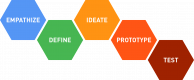
The Design Thinking (DT) process comprises five distinct stages: empathize, define the problem, ideate, prototype, and test.
In today’s increasingly complex world, we encounter challenges that demand specialised approaches. Design Thinking offers a robust framework for tackling such complexity. By mastering Design Thinking, you can address difficult problems with greater efficacy, enhance your communication and persuasion skills, improve business outcomes, and elevate both organisational and personal behaviour and performance.
How DT works: Learn from people and the problem, identify patterns, design a model (understanding model drift), test the model, evaluate it, and re-engineer as necessary.
The relationship between DT, innovation, and entrepreneurship.
DT methods and tools: persona development, stakeholder mapping, customer journey mapping, service blueprints, and business model innovation.
Application of DT: Cultivating a design mindset, driving disruptive innovation, adopting an iterative approach, utilising agile estimation techniques, and honing critical thinking, problem-solving, teamwork, leadership readiness, and communication skills. Additional focus areas include technological savvy, forward-thinking, intercultural and ethical competency, emotional intelligence, self-awareness, negotiating skills, and conflict resolution.
Objectives:
To grasp the fundamentals and nuances of DT.
To explore key concepts, factors, theories, types, and models within DT.
To experiment with, experience, and practice DT.
Delivery:
This is a one-day (4-hour) training course structured as follows:
lectures (40% - presentation of theories, concepts, models, and interactive discussions),
group exercises (30% - focusing on group dynamics, games, group discussions, and mock conflict resolution exercises),
individual activities (15% - writing, designing, and peer discussions)
and other materials (15% - videos, reading).
Note: Due to the interactive nature of this course, a minimum group size of 3 is required.
This instructor-led live training in Durban (online or onsite) is aimed at intermediate-level PHP developers who wish to apply design patterns effectively in their projects.
By the end of this training, participants will be able to:
Understand the purpose and benefits of design patterns.
Identify and implement appropriate design patterns for common scenarios.
Structure PHP applications using industry-recognized best practices.
Integrate patterns into modern frameworks such as Symfony or Zend.
This live training in Durban delves into embedded C design principles, enabling developers to navigate reliability, functionality, and logical structure. It features hands-on exercises focused on crafting error-free applications, optimizing hardware performance, and mastering system constraints, code reusability, and maintainability.
This intensive 14-hour advanced JavaScript course in Durban is aimed at developers constructing complex web applications. It delves into object-oriented programming, design patterns, and asynchronous communication strategies such as Promises and RxJS, with a primary focus on applying best practices to optimise code structure.
Tailored for experienced developers, this 21-hour course in Durban delves into design patterns and refactoring strategies. Through practical sessions, participants will master GoF patterns, enterprise architecture, and essential tools to create efficient, maintainable PHP application code.
This comprehensive Durban course explores RISC-V architecture, assembly, Linux, FPGA, and AI applications. It addresses the global talent shortage by building expertise from ISA fundamentals to advanced SoC design, making it ideal for engineers aiming to master modern, open-source computing stacks.
In this live training conducted in Durban, participants will delve into the profound interplay among software, technical, and enterprise architecture. You will learn to navigate the complexities of distributed systems and associated trade-offs, while mastering established patterns for SOA, microservices, and efficient inter-system communication.
This course in Durban equips developers and architects with the necessary skills to succeed in the UML2 Intermediate exam. The curriculum focuses on complex modeling techniques, classification structures, and state machine design. By mastering these core design elements, you will be able to build detailed UML models and qualify as a senior member of a UML development team.
Read more...
Last Updated:
Testimonials (6)
Trainer knowledge, involvement, and rapport
Adam Kuklewski - GE Medical Systems Polska
Course - Technical Architecture and Patterns
complete, subject-focused, with multiple exercises and examples
Grzegorz Sposob - ASSECO POLAND S.A.
Course - OCUP2 UML Certification - Preparing for the UML2 Intermediate exam.
The explanations and interactivity of the trainer, he really brought the subject well; and even-though I was probably not experienced enough, I did learn a lot from it!
Pieter Bruynseels - Spot Buy Center BV
Course - Design Patterns
I liked the exercises that helped to open the mind and gain new insights into software architecture.
Gabriele - EAGLEPROJECTS S.p.A.
Course - Architecture and Design: Core + Advanced Training
I liked the platform we used. It was really nice and easy to use. I liked the typescript section, the part about namespaces and modules.
Online Software Design training in Durban, Software Design training courses in Durban, Weekend Software Design courses in Durban, Evening Software Design training in Durban, Software Design instructor-led in Durban, Software Design instructor in Durban, Software Design boot camp in Durban, Online Software Design training in Durban, Software Design one on one training in Durban, Software Design instructor-led in Durban, Software Design coaching in Durban, Evening Software Design courses in Durban, Software Design on-site in Durban, Software Design classes in Durban, Weekend Software Design training in Durban, Software Design trainer in Durban, Software Design private courses in Durban